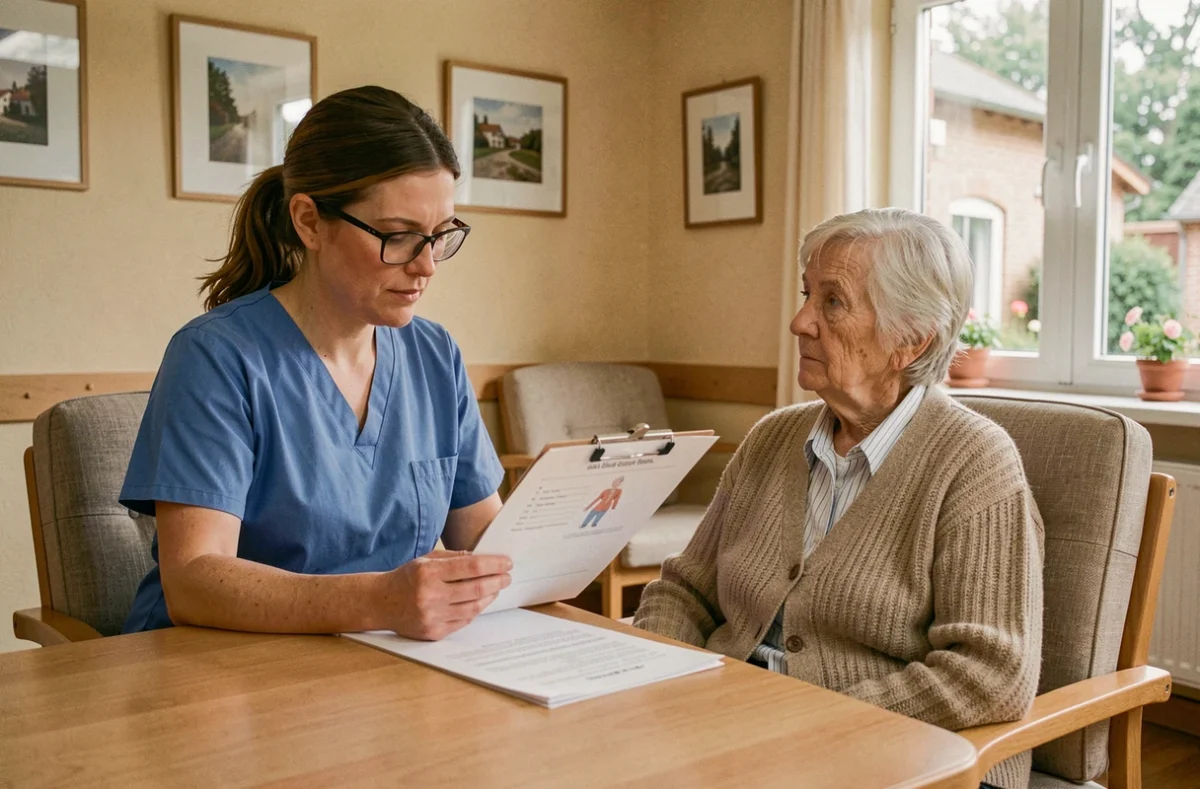
A resident slips while getting up from their chair at breakfast. The caregiver notes the incident, and the coordinating physician requests an assessment of balance. The team then looks for a quick, reliable tool that is understandable by all professionals in the service. The Tinetti test has met this need for decades, but it is essential to have a readable and ready-to-use French version.
Scoring the Tinetti test: what the score alone does not convey
The Tinetti test (also known as POMA, Performance Oriented Mobility Assessment) evaluates static balance and gait through a series of observed items. Each item is scored, and the overall score provides an indication of the level of fall risk.
Depending on the version used, the maximum score varies. Some scales total 28 points (16 for balance, 12 for gait), while others go up to 35 points (26 for balance, 9 for gait). This difference is not trivial: the risk thresholds change depending on the version of the scale. Using a threshold from one version on a different scale distorts the interpretation.
More fundamentally, the Tinetti score does not predict a fall on its own. The published thresholds vary according to the populations studied. A recent review recommends using it to identify and monitor a balance disorder, not as a substitute for a multifactorial fall risk assessment. The care team that relies solely on the final number misses the real triggering factors.
To have a clear and directly usable scale within the team, the Tinetti test PDF in French offers a simplified version tailored for professionals in nursing homes.
Administering the Tinetti in nursing homes: practical conditions for observation
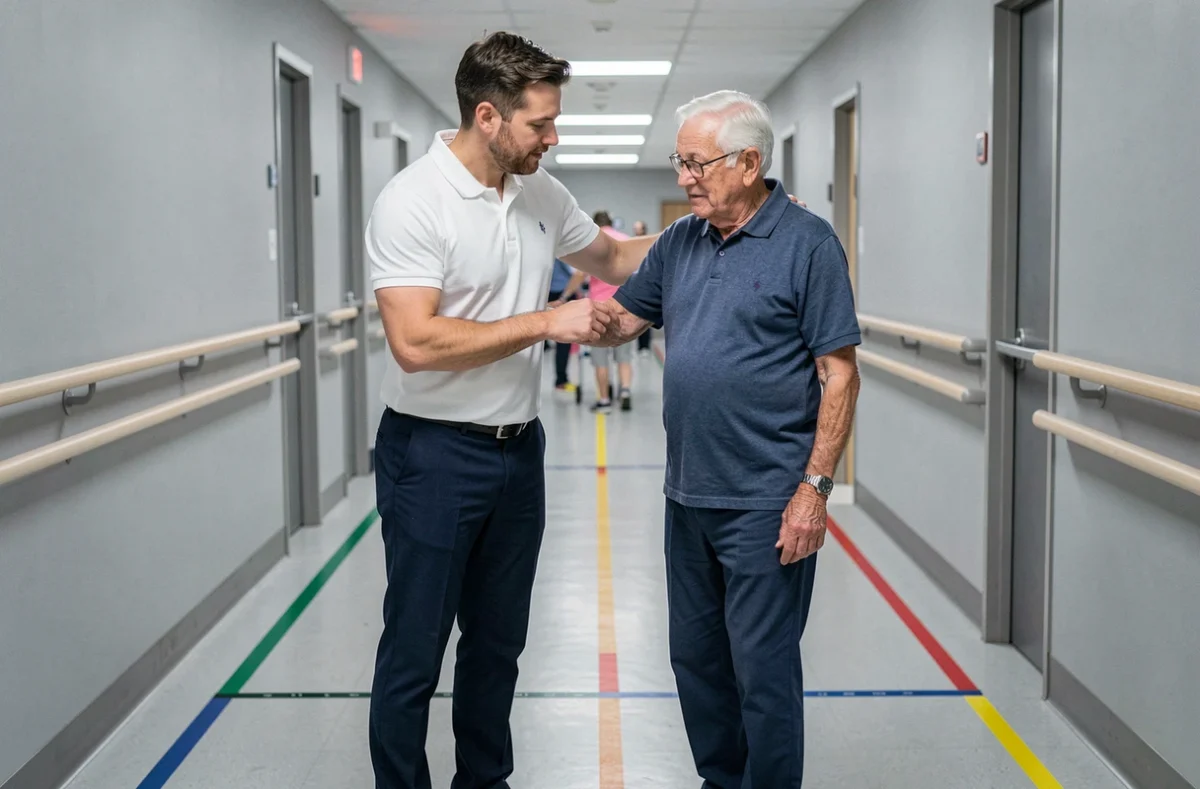
The administration lasts a few minutes. The resident sits on a hard chair without armrests. The examiner successively observes sitting balance, standing up, standing (feet together, eyes open then closed, after sternum push), turning around, and sitting back down.
For the walking part, the resident moves down a corridor at their usual pace, then returns at a faster pace. The examiner notes the length of steps, their symmetry, foot height, fluidity, and trajectory.
Have you ever noticed that a resident walks very differently in the morning compared to the end of the day? This is one of the practical limitations of the test. The timing of the administration directly influences the result. A resident assessed after a restless night or before taking their medications will not produce the same score as in mid-morning. Noting the time and context on the form is a simple precaution that adds meaning to subsequent comparisons.
Another practical point: the shoes worn. Open slippers or inappropriate shoes alter the gait. Ideally, the administration should be standardized with the shoes that the resident typically wears in the facility.
When to redo the Tinetti test: clinical triggers rather than a schedule
Scheduling an assessment every three or six months out of habit has limited value if nothing has changed in the resident’s condition. In contrast, re-evaluation is relevant after a specific clinical event.
Situations that warrant retaking the test include:
- A fall, even without apparent consequences, as it may indicate a previously unrecognized deterioration in balance.
- A hospitalization or prolonged bed rest, which leads to rapid loss of muscle strength and proprioceptive cues.
- A change in medication, particularly the addition or modification of psychotropics, antihypertensives, or diuretics.
- A sudden deterioration in autonomy, nutritional status, or cognition.
This logic aligns with the expectations of the HAS regarding fall risk assessment and the adaptation outlined in the support project (criterion 2.4.3 of the quality evaluation framework for ESSMS, commented by SOS EHPAD in September 2026).
Tinetti and multidisciplinary assessment: factors that the scale alone does not capture
The Tinetti test measures balance and gait. It does not measure vision, hearing, cognitive state, continence, or nutrition. All these factors contribute to fall risk.
A resident who scores well on the Tinetti may fall because they do not hear a cart approaching from behind, because they get up hastily to go to the bathroom at night, or because orthostatic hypotension related to a medication causes them to lose balance. The Tinetti identifies motor impairment, not the cause of the fall.
The fall prevention protocol in nursing homes described by EHPADéo (September 2026), based on recommendations attributed to the HAS, emphasizes the connection between the motor evaluation scale and an assessment covering:
- Risky medications (psychotropics, antihypertensives, hypoglycemics).
- Vision and hearing, which remain insufficiently screened in institutions.
- Nutritional status and hydration, which affect muscle strength and alertness.
- Cognition and behavioral disorders, which alter the perception of danger.
Without this intersection, the Tinetti score remains an isolated number in a file. With it, it becomes the starting point for an individualized action plan.
PDF version in French: choosing the right scale for your team
Several versions of the test circulate online. Some are low-quality scans, while others mix two scoring systems on the same document. Before printing a scale for the entire team, check two points.
The first: the scoring must be consistent throughout the document. If the balance section is scored from 0 to 2 per item and the gait section from 0 to 1, the overall maximum score must correspond. A PDF that displays a total of 28 while the summed items give 35 creates confusion.
The second: the scale must be readable by all professionals filling it out, not just the physiotherapist. Clear headings, an airy layout, and summarized administration instructions at the top of the page facilitate understanding for caregivers and nurses.
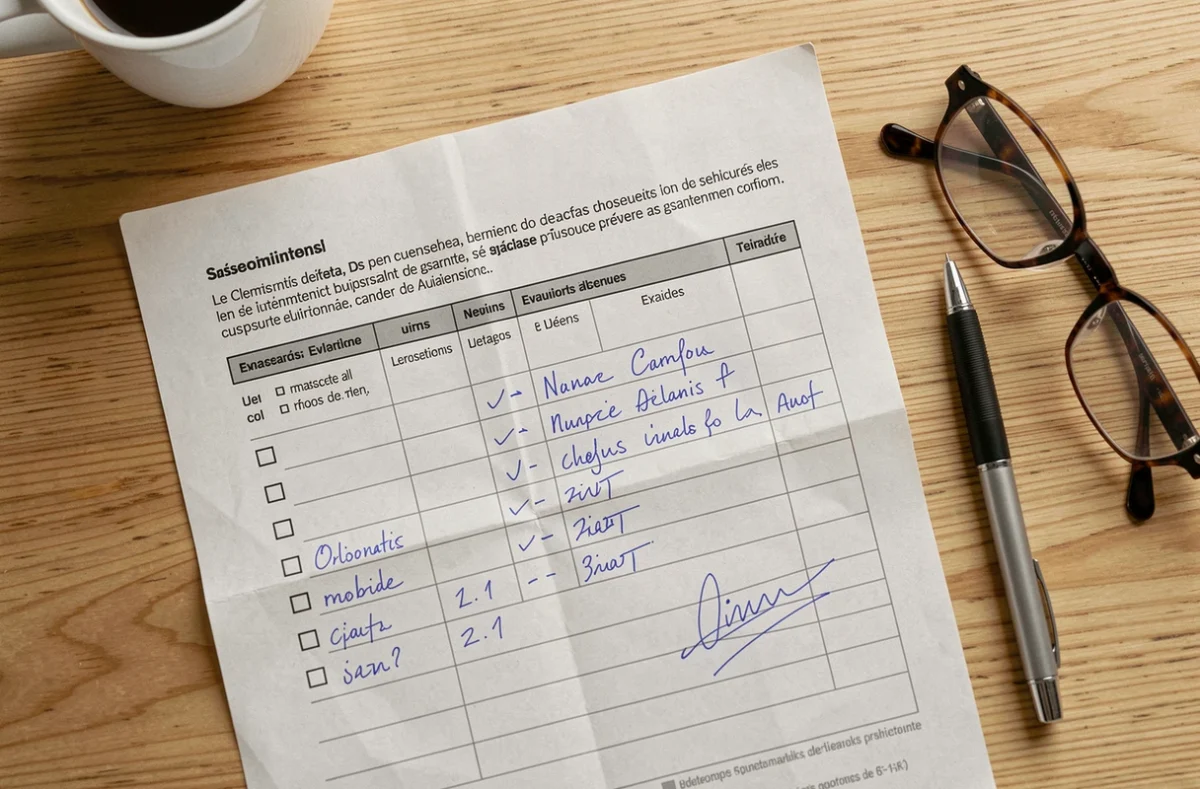
One last practical point: archive each completed scale in the resident’s file with the date, time, evaluator’s name, and context (shoes, assistive device used). This tracking is essential for ensuring that successive scores tell a clinically useful story during multidisciplinary meetings.